ANALYSIS
How Usmanov and Fridman were removed from the EU sanctions list
On 22 September 2026 the EU Council removed Alisher Usmanov and Mikhail Fridman from its sanctions list and at the same time extended the regime for everyone else by 36 months. We look at which remedies led to this and which of them are available to other listed persons.
- Published
- 25 September 2026
- Author
- Vladimir Kovalev
- Topic
- International law and sanctions
- Reading
- 7 min
The news of the delisting raises an obvious question: does this mean one can now get off the EU list through the courts? The short answer is that a court judgment does not open the list on its own. Below, using the two most prominent cases, is how it actually works.
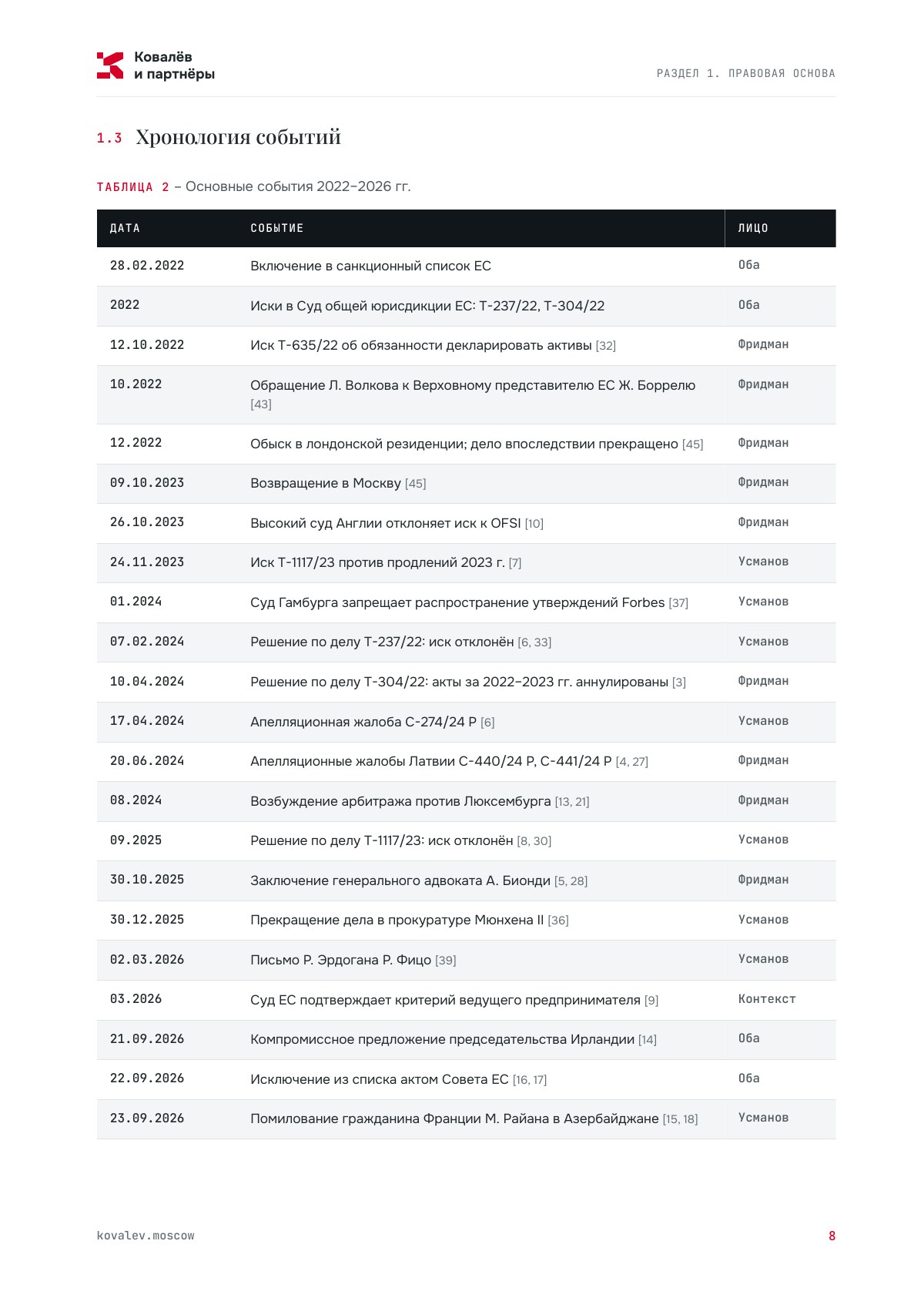
Since 2022 we have been advising clients on international law and sanctions and following the case law. That is why we prepared an analytical study of this case: 24 pages, a timeline, tables and 47 sources. Download PDF (in Russian).
What happened on 22 September
The personal restrictive measures regime is based on Council Decision 2014/145/CFSP and Council Regulation (EU) No 269/2014, both of 17 March 2014, concerning actions undermining or threatening the territorial integrity, sovereignty and independence of Ukraine. On 22 September the EU Council removed two entries from the list: No 673 (Alisher Usmanov) and No 675 (Mikhail Fridman). For everyone else the regime was extended by three years, that is roughly until September 2029, instead of the usual six months. According to European media, the Irish presidency proposed the compromise on 21 September, and the next day Latvia, which had objected until the very end, used constructive abstention, which secured unanimity.
US and UK measures against both businessmen remain in force. The EU Council decision does not affect them.
The court did not decide the outcome, but it mattered
Before the EU courts Fridman won and Usmanov lost. Yet both were removed from the list.
Fridman. By its judgment of 10 April 2024 in Case T-304/22 the General Court annulled the acts listing him and extending the listing for the period from 28 February 2022 to 15 March 2023. The court found that the Council had not proved material or financial support for Russian decision-makers. From March 2023, however, the Council updated the grounds for listing, so the later acts remained in force and had to be challenged separately. After that judgment Fridman stayed on the list for about two and a half more years.
Usmanov. His action in Case T-237/22 was dismissed on 7 February 2024, and his action against the 2023 extensions (T-1117/23) was dismissed in September 2025. The outcome of his appeal in the first case (C-274/24 P) could not be found in open sources.
The practical conclusion: every listing and extension act is a separate subject of challenge, and the burden of proving that the listing is well founded lies with the Council. Annulling one act does not cancel the next one, but court findings of insufficient evidence accumulate and are later used as an argument outside the courtroom.
What worked besides the courts
In both cases the defence was not limited to the EU courts. Open sources show several lines of work running at the same time.
Challenging the factual basis. The Council relied on media publications when listing Usmanov. According to his defence, since 2023 it has obtained 16 court decisions and 102 undertakings to stop disseminating statements. In January 2024 a Hamburg court prohibited Forbes from disseminating the statements the Council had relied on. In Germany two criminal cases were closed, one of them upon payment of EUR 10 million and without an admission of guilt.
Investment arbitration. Fridman brought proceedings against Luxembourg under the 1989 Agreement between the Belgium-Luxembourg Economic Union and the USSR on the reciprocal promotion and protection of investments (PCA Case No. 2025-42, claims of about USD 16 billion), as well as against the United Kingdom and the Netherlands. The claims exceed 40 % of Luxembourg's annual central government expenditure. According to media reports, this very risk is why Luxembourg demanded Fridman's removal.
Support from other states. For about two years Uzbekistan and other Turkic states sought Usmanov's delisting. The decisive factor was the position of France, which joined the request shortly before the extension deadline and officially cited national security considerations. According to diplomatic sources, the arrangement concerned pardons for French citizens convicted in Azerbaijan. France did not confirm such an arrangement and Azerbaijan denied any pressure; on 23 September, however, French citizen M. Ryan was pardoned.
Why this became possible: unanimity
The regime can only be extended with the consent of all member states. A single country can block the entire list, including Russia's top officials. That is why the expiry of the measures becomes the moment when individual states can make their consent conditional on their own demands: France needed a diplomatic result, Luxembourg a financial one. The scheme is now known to everyone involved, but whether it will be repeated cannot be predicted: it all depended on a particular combination of interests of particular states.
What is available to an ordinary listed person
Investment arbitration with multi-billion claims and arrangements between states are available to very few. Everyone else has other tools, and they only work in combination.
- Challenge each act separately. An action before the General Court must be brought within two months of the publication or notification of the act (Article 263 of the Treaty on the Functioning of the European Union), extended by ten days on account of distance. Each act has its own deadline, so the dates of extensions need to be tracked.
- Take the Council's statement of reasons apart. Which sources it relies on, whether media publications are among them, and what is supported by up-to-date evidence. Context may supplement evidence but cannot replace it.
- Gather documents that refute specific allegations. Not general statements about reputation, but certificates, statements, court decisions and corporate documents.
- Consider protecting business reputation in national courts where the statement of reasons relies on publications that can be challenged on the merits.
- Check the US and UK measures. Delisting in the EU does not affect them, and actually unfreezing assets requires action by national authorities and takes time.
What not to do
Do not treat a court win as delisting. The Council may update the grounds, and a person stays on the list even after earlier acts are annulled.
Do not treat a court loss as the end. But Usmanov's case is not a recipe either: circumstances came together there that cannot be reproduced to order.
Do not rely on public appeals by well-known people. In 2022 and 2023 appeals by public figures in support of one of the businessmen had a negative reputational effect, and this approach was abandoned.
Do not wait for a "wave of delistings". The decision is tied to a specific compromise within the EU. A repeat depends on other people's interests, and building a strategy around it is risky. Moreover, relisting on the basis of new evidence is legally possible.
This article is for information only and is not a substitute for advice on a specific case. We do not guarantee or promise any outcome; it depends on the circumstances of each case.
If this concerns you, the first consultation is free when an engagement agreement is signed.
Vladimir Kovalev — lawyer, founder and managing partner of Kovalev & Partners LLC
Analytical study
Legal and interstate mechanisms for removing persons from the EU sanctions list
Timeline, comparative tables, case register and 47 sources.
PDF · 24 pages · 47 sources · 3 tables (in Russian)


NEXT STEP
Facing a similar situation?
Describe it in two or three sentences and we will tell you which scenario is realistic and where to start.